John was eight years old when his parents made the decision to emigrate to the newly established colony of Massachusetts Bay in North America. Surviving records reveal that the family began their 3,000 mile ocean journey from the English port of Ipswich on November 30, 1634. A 15-year-old girl named Mary Winch came with them; she may have been a relative or a servant. The family traveled on the ship Francis, landing at Boston. From there, they traveled to Roxbury, Massachusetts, where they settled.
Five years after their arrival in Roxbury, Rowland Stebbins relocated his family to the newly settled town of Springfield, Massachusetts, on the Connecticut River. Perhaps the promise of good land lay behind the decision to move; an early map of Springfield shows that John’s father owned land on both sides of the Connecticut River in addition to two other parcels of land. Rowland was also good friends with Springfield’s founder, John Pynchon, who came from the same part of England as the Stebbins family. Like the other early settlers of Springfield, Rowland had to live there for at least five years to keep his land grant. Town records reveal that Rowland Stebbins stayed in Springfield for the required five years and actively participated in the community. John’s mother, Sarah, died there in 1649 when John was 23 years old.J
John Stebbins was probably a farmer; taxed for 27 1/2 acres land 1646 Springfield MA; 2 acre land grant Springfield MA 21 Feb 1649: Roxbury MA 1651; 3 acre land grant Springfield MA 25 Dec 1651; 10 acre land grant Springfield MA 30 Jan 1655;
Another account says: John settled in Northampton MA 1656; marr 2nd 17 Dec 1657 Northampton MA Abigail BARTLETT, Abigail died after John, 10 Oct 1710, killed by a fall from her horse, while passing through South Hadley Falls on her way to visit her and John’s children. Note that Abigail went on to marry Jedediah Strong after being widowed by John Stebbins.
John Stebbins and Mary Anne Munson Married May 14 1646. Mary Anne was the widow of Abraham Munden. Abraham drowned in the Connecticut River Oct 29, 1645.
Mary Anne Munson Stebbins died in 1656, at Springfield Mass.
Consider that
“Justice in 17th Century Deerfield.” Cases selected by Kevin Sweeny states: May 2, 1655
(John’s son at 8 years old… )John Stebbins Jr. (b 1647) beinge taken notice for misbehavinge himself towards his aged Father calling him Old foole and uttering other unseemingly words toward him was the day above said examined thereof: and the matter beinge not ripe for fynall issue, the said John Stebin did before the Commissioners bynd himselfe in the summ of Forty pounds to appeare before Authority here established to make answer for the said misbehaving himselfe to his Father when he shall be thereunto required.
This matter beinge further considered there was not found full proofe of such evil carriage whereupon he was released and discharged of his bond above mentioned:
Pynchon Court Record, p. 234.
More on John: He was a farmer at Springfield and Northampton. and in 1651 was for a time at Roxbury. He had grants of land at Springfield, and bought a house there. He was highway surveyor; selectman in 1655. In
The office of Townsman, later called Selectman, is an ancient one in New England. The first mention of it in the Springfield records is on “26 of the 7 m. 1644” In September 1646 their duties included that they shall reach to reconcile disagreement & disputes between neighbor and neighbor. (and many others related to oxen and cows, bridges and highways, and much more in the order of living in those days.
1656 he moved to Northampton and his home was on the lower end of Pudding Lane, now Hawley Street. See the lower right corner of the attached PDF map.
John owned [a share in?] saw mills there; was measurer of land in 1659-71 ; committee to lay out highways in 1660 ; juror in 1661 l selectman in 1675-78. He owned (some records say signed) the covenant in the church, June 18, 1661, served on the church building committee the same year. Was bailiff 1664 ; contributed to the Harvard College fund 1672-73 ten bushels of wheat. It was commonly believed that he was killed by witches. He was part owner of the mill on Broadbrook and was killed in some mysterious way while alone in the mill.
His second wife Abigail Bartlett who was killed October 10, 1710 in a fall from her horse on a visit to her children at Coventry Connecticut.
This from “Genealogical and Personal Memoirs Relating to the Families of the State of Massachusetts, Volume 2” by
William Richard Cutter, William Frederick Adams Lewis historical publishing Company, 1910
Taken from Genealogical and Personal Memoirs Relating to the Families of the State of Massachusetts Volume 3, By William Frederick Adams · 1910
John apparently returned to Roxbury at some point, as he came from there when he purchased his own land in Springfield in 1651. Sometime in the 1660s, John’s father Rowland moved to Northampton, Massachusetts, about 20 miles from Springfield. John settled there, too, and he was also among the early landowners of Pocumtuck (Deerfield.) Most reports say that Rowland lived with his son John in Northampton. Rowland Stebbins died on December 14, 1669, aged 77 and is buried at the Bridge Street Cemetery in Northampton. Rowland’s remains could not be found so a Dr. Daniel Stebbins (descendant of Rowland) erected a monument to Rowland at the Bridge St. Cemetery in Northampton, MA. Rowland’s will named John as the executor of his estate. Rowland’s instructions to leave his land to surviving male children and money or goods to female children was typical of the time. He left special bequests of clothing, household goods, and money to his daughters and grandchildren. He divided the remainder of his estate between his two sons, Thomas and John.
John Stebbins’s branch of the Stebbins family tree
John Stebbins (1626-1679) married twice. On May 14, 1646 he married Mary, widow of Abraham Munden, probably the daughter of Thomas Munson of Hartford. Their children were:
- John Jr. born 1647
- Thomas, d. 1649
- Ann, born 1651
- Edward, born 1653
- Benoni, born 1655
John married his second wife, Abigail Bartlett of Northampton on November 17, 1657. Their children were:
- Samuel, born 1658
- Abigail, born 1660
- Thomas, born1662
- Hannah, born 1654
- Mary, born 1666
- Sarah, born 1668
- Joseph, born 1670
- Deborah, born 1672
- Benjamin, born 1674
- Rebecca, born 1676
- Thankful, born 1679
John Stebbins was 53 years old when he died March 9, 1679, “in an unusual manner” that raised concerns that witchcraft may have been involved. A jury of inquest was called and found “several hundred spots, small ones as if they had been shot with a small shot which we scraped and under them were holes I[n] his body.” An investigation followed and the evidence laid before the court in Boston, but no prosecution followed.
John’s death 7 MAR 1678 was ‘probably’ by accident at his sawmill.Northampton MA,
The manner of his death was unusual and it was commonly supposed that he was killed by witches. He probably met his death in some accident in The Sawmill of which he was part owner. It is said that “ while sewing at his meal, the logs would roll over him, set in motion by Witches, by which he was severely bruised.” The inquest was held, and showed that more than half of the journeyman believed that his death was due to Supernatural means. The first report said that there was a “warmth and heate in his body yt dead persons are not usual to have;” and that there were “fower places upon his breast yt seem to have been pintched, though the doctor informed ym that in his lifetime there was a swelling between the pintches.” His neck was as flexible as that of a living person; upon his body were found “ several hundred of spots,” that looked as if they had been “shott with small shott,” and when they were scraped there were holes under them. On the second examination, Maiden soon after the first one, they found, “the body somewhat more cold than before, his joints more limber,” and several bruises not previously discovered. A large number of women were summoned by Joseph Hawley to examine and touch him, to see if the witch could be found. Blood flowed when a certain woman touched him but only one could see it, so nothing was done.
Although he owned land in Deerfield, John apparently never settled in there, but his sons, John Stebbins, Jr. (1647-1724) and Benoni (1635-1704) did. John, Jr. led an eventful life, including being captured with his entire family in a raid on the town in 1704 by the French and their Native allies. Only John, his wife Dorothy, and his son John Jr. returned; descendants include family members born to the children who did not return from Canada. John Stebbins’s son Benoni (John Jr.’s brother) was captured by a raiding party led by Ashpelon, a Pocumtuck sachem in 1677 as King Philip’s War (Metacom’s War) drew to a close in southern New England. Benoni escaped his captors and returned to Deerfield five years later, building a house on his father’s land in 1682 that was burned in the raid on the town in 1704. Benoni was among the 50 people killed in the attack.
Because John Stebbins died intestate (without a will) the colony courts apportioned his estate among his widow and children.
Division of John Stebbins Estate
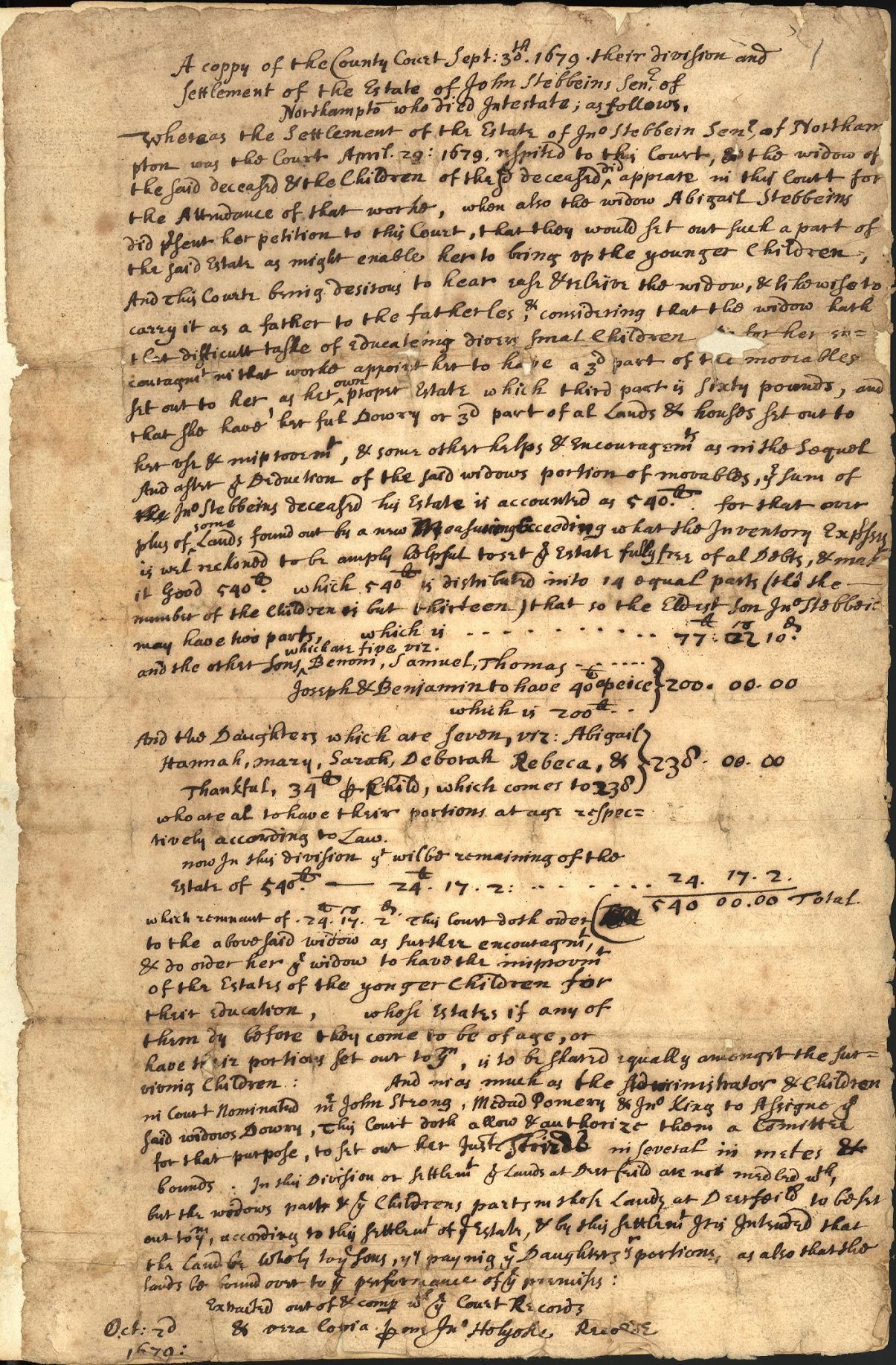
A coppy of the County Court Sept: 30th. 1679 their division and Settlement of the Estate of John Stebbeins Senr. of Northampton who died Intestate; as follows,
Whereas the Settlement of the Estate of Jno Stebbein Senr of Northam pton was the Court April: 29: 1679, respited to this Court, & the widow of the said deceased & the Children of the sd deceased, appeare in this Court for the Attendance of that worke, when also the widow Abigaile Stebbeins did present her petition to this Court, that they would set out such a part of the said Estate as might enable her to bring up the younger Children, And this Court being desirous to heare case & Incline the widow, & likewise to carry it as a father to the fatherles; & considering that the widow hath a difficult taske of educating divers smal Children, for her en= couragemt in that worke appoint her to have a 3d part of the movables set out to her as her own proper Estate which third part is sixty pounds, and that she have her ful Dowry or 3d part of al Lands & houses set out to her use & improvemt, & some other helps & encouragemt as in the Sequel And after ye Deduction of the said widows portion of movables, ye sum of the Jno Stebbeins deceased his Estate is accounted as £540. for that over plus of some Lands found out by a new Measuring exceeding what the Inventory Expresses is wel reckoned to be amply helpful to set ye Estate fully free of al Debts, & make it Good 540£ which 540£ is distributed into 14 equal parts (tho the number of the children is but thirteen) that so the Eldest Son Jno Stebbein may have two parts, which is – – – – – – – – – £ 77 : 02 : 10 : and the other sons, which are five viz. Benoni, Samuel, Thomas – Joseph & Benjamin to have 40£ peice } 200 . 00 . 00 which is 200£ – – – And the Daughters which are seven, viz: Abigail, Hannah, Mary, Sarah, Deborah, Rebeca, & } 238 . 00 . 00 Thankful, 34£ p child, which comes to 238 } who are al to have their portions at age respec= tively according to Law. now In this division yr wil be remaining of the Estate of 540£ – – 24 . 17 . 2 : – – – – – – – 24 . 17 . 2 . _____________________________________________ £540 00 . 00 Total which remnant of 24. 17. 2. this Court doth oder [order] to the abovesaid widow as further encouragemt, & do order her ye widow to have the improvemt of the Estates of the yonger children for their education, whose Estates if any of them dy before they come to be of age, or have their portions set out to ym, is to be shared equally amongst the sur= viving Children : And in as much as the Administrator & Children in Court Nominated mr John Strong, Medad Pomery & Jno King to Assigne ye said widows Dowry, this Court doth allow & authorize them a Committee for that purpose, to set out her Just Thirds in several in metes & bounds . In this Division or settlemt ye lands at Deerfield are not medled wth, but the widows parts & ye childrens parts in those lands at Deerfield is to be set out to ym, according to this settlemt of ye Estate, & by this settlemt yt is Intended that the lands be wholy to ye sons, yt paying ye Daughters portions, as also that the lands be bound over to ye performance of ye premisses : Extracted out of & comp wth ye Court Records Oct: 2d 1679 : & vera Copia. p[er] me Jno Holyoke, Recordr
Modern Language Translation of John Stebbins’ Will
This document, dated September 30, 1679, is a probate court record detailing how the estate of John Stebbins Sr. of Northampton, Massachusetts, is to be divided. Because he died “intestate” (without a valid will), the local court had to legally mandate how his wealth and property would be split among his surviving widow and children. Because John didn’t leave written instructions for how his property should be divided, the County Court had to step in and make those decisions for him.
The court based its distributions on a combination of:
The Law/Custom of the Time: Following the English tradition of primogeniture (giving the eldest son a double portion) and ensuring all other children received a share.
The Widow’s Petition: Abigail explicitly asked the court for enough of the estate to survive and raise her minor children, which is why the court granted her the extra £24 and the “improvement” (use/income) of the younger children’s inheritance until they came of age.
Key Context & The Widow’s Share
- The Widow’s Burden: Abigail Stebbins petitioned the court for enough money to raise her many young children. The court, acting “as a father to the fatherless,” agreed she had a difficult task and granted her extra support.
- The Widow’s Allowance: She was given £60 outright (representing one-third of the “movable” or personal property). She was also granted her legal “Dowry,” meaning she gets to use and collect the income (“improvement”) from one-third of all real estate (houses and lands) for the rest of her life.
The Financial Math & Division In 1679, currency was calculated in Pounds (£), Shillings (s), and Pence (d). There were 20 shillings in a pound, and 12 pence in a shilling.
- Total Estate: After deducting the widow’s £60, the remaining estate is valued at exactly £540. (A recent land survey found extra property that neatly paid off all the deceased’s outstanding debts, leaving a clean £540).
- The Shares: John Sr. had 13 surviving children. Following the English custom of primogeniture, the estate is divided into 14 shares so the eldest son can inherit a “double portion.”
- John Jr. (Eldest Son): Receives 2 shares totaling £77, 2 shillings, and 10 pence.
- The 5 Younger Sons: Benoni, Samuel, Thomas, Joseph, and Benjamin each receive £40. Total = £200.
- The 7 Daughters: Abigail, Hannah, Mary, Sarah, Deborah, Rebecca, and Thankful each receive £34. Total = £238.
- The Remainder: £77.2.10 + £200 + £238 equals £515, 2 shillings, and 10 pence. Subtracting this from the £540 total leaves exactly £24, 17 shillings, and 2 pence.
Court Rulings & Provisions
- Widow’s Bonus: The court gives that leftover £24.17.2 directly to Abigail as extra funding to raise the children. Furthermore, she is allowed to use the children’s inherited wealth to pay for their education until they come of legal age.
- Survivorship: If any child dies before coming of age, their inheritance will be split evenly among the surviving siblings.
- Surveying the Land: The court appointed a committee of three men (John Strong, Medad Pomery, and John King) to officially measure the boundaries (“metes and bounds”) of the widow’s land so she gets her fair third.
- The Deerfield Property: John Stebbins also owned land in nearby Deerfield. The court decides not to split the physical dirt among all 13 kids. Instead, the sons will inherit the actual real estate, but they are legally bound to pay their sisters the cash equivalent of their shares. The land acts as collateral (“bound over”) until the sisters are fully paid.